
UNODC and European Union Lead Regional Efforts to Enhance Strategic Communications in the Digital Space to Prevent Violent Extremism among Youth in Central Asia
In Central Asia, as in other regions of the world, violent extremism continues to pose a complex and evolving challenge, with digital platforms playing an increasingly central role in the spread of radical ideologies. Violent extremist organizations affiliated with Al-Qaida and the Islamic State in Iraq and the Levant (ISIL/Da’esh), including ISIL-Khorasan Province, have intensified their use of online spaces to radicalize and recruit, particularly among youth populations.
Using a combination of in-person and digital engagement, violent extremist organizations disseminate propaganda through regional and cross-regional channels to advance their objectives globally. Harmful narratives often target vulnerable youth, exploiting their search for belonging and identity, or capitalizing on existing risk factors such as access to education or economic opportunities. In response to these trends, there is growing recognition of the need to invest in youth empowerment, including by equipping young people with the digital expertise and resilience needed to identify, prevent and counter risks in the digital space.
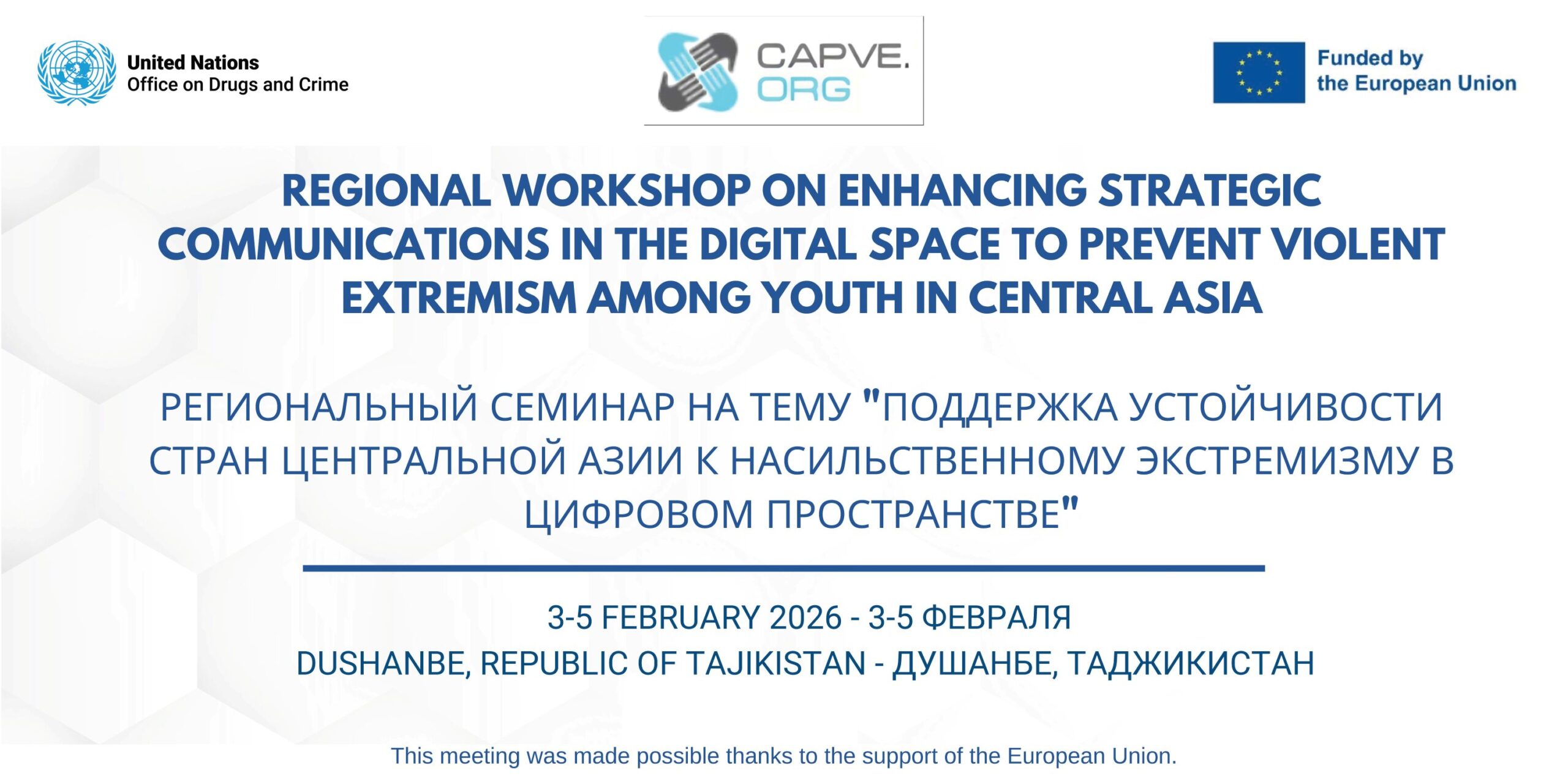
In this context, UNODC convened the “Regional Workshop on Enhancing Strategic Communications in the Digital Space to Prevent Violent Extremism among Youth in Central Asia” in Dushanbe, Tajikistan, on 3-5 February 2026. The workshop was funded by the European Union and implemented under the project “Supporting Asian Countries’ Resilience to Violent Extremism in the Digital Space” (2025-2028). This activity included participants from Kazakhstan, Kyrgyzstan, Tajikistan, Turkmenistan, and Uzbekistan, and follows similar workshops delivered for the South Asia and Southeast Asia regions.
Mr. Maksudjon Duliyev, Head of the UNODC Program Office in Dushanbe, Tajikistan, delivered opening remarks stressing that the UN Secretary-General’s Plan of Action to Prevent Violent Extremism calls for a comprehensive approach to the threat of violent extremism—not only focused on suppressing threats, but also on building resilient communities. He highlighted the power of strategic communications, described as not merely ‘counter-propaganda’ but a systematic effort to debunk false narratives, promote positive alternatives and constructive values, and enhance the digital and media literacy of young people.
Mr. Umed Amanov, a Prosecutor at the Prosecutor General’s Office of Tajikistan, highlighted the country’s national Plan of Action on Prevention of Violent Extremism (PVE) and emphasized the need for early prevention and comprehensive efforts by all levels of the society. He further noted that the growing misuse of digital spaces by terrorist and criminal groups underscores the need for strategies to safeguard them.
Ms. Isabel Uriz Hernandez, Head of Cooperation of the European Union Delegation to Tajikistan, described the prevention of violent extremism as promoting and protecting the values and ideas that make societies open and safe. She reaffirmed the European Union’s commitment to work with Central Asian partners in strengthening resilience in the digital space and supporting a sustainable development grounded in good governance, rule of law, and respect for human rights.
Mr. Sudipto Mukerjee, Resident Representative of UNDP in Tajikistan, highlighted the joint action of UNDP and UNODC under the European Union project, and noted how UNDP’s complementary activities focusing on youth empowerment and communications were relevant to the themes of the workshop, as they illustrate the power of authentic youth voices such as youth-led CSOs and popular influencers.
Over three days, participants exchanged national experiences, shared good practices and explored how strategic communications were integral to the protection of youth in the digital space. Experts representing the European Union’s Knowledge Hub on Prevention of Radicalization discussed and promoted the strategic communications model GAMMMA+, which provides a framework to set messaging goals; identify credible and effective messengers; and develop precise actions to deliver communications. Experts also emphasized complementary principles such as effective emotional communication in times of crisis, mobilization of youth action, and understanding of modern tools, platforms, and trends driving digital engagement.
One study introduced at the workshop noted that the region’s youth connectivity to the internet outpaces that of adults; internet use in the region ranges from 57 to 93 percent, depending on the country, and virtually every young adult is exposed to content from major social media platforms. In this context, participants discussed the risks of violent extremism facing a growing population of youth in online spaces. Leaders of CSOs and youth-centered outreach their shared experiences in developing and implementing strategic communications campaigns. They described a complex digital landscape where violent extremist narratives have increased in variety and overlapping themes, and where actors evade detection and content removal by “platform-hopping” between social media, gaming spaces, and gaming-adjacent platforms such as chat services. On the other hand, well-structured campaigns illustrate positive results achieved by strategic communications and counter-narratives, particularly when such messages are crafted and delivered by credible and trusted messengers.
The experts and participants agreed that, in response, it was essential to treat digitally-savvy young people as partners and leaders in the digital space who can build resilience for themselves and their peers—not merely an “at risk” population.
Building on these discussions, representatives of social media companies and other digital services presented various approaches to digital safety, including platform-specific policies and proactive techniques using both automation and human-based intervention to identify, catalog, investigate, and remove violent extremist content.
Finally, the workshop highlighted the Central Asian Network on Preventing and Countering Violent Extremism (CAPVE) and its use as a platform for government and civil society representatives to collaborate and share knowledge on PVE efforts, especially through working groups dedicated to topics such as strategic communications. The workshop featured a discussion on practical actions and next steps to enhance PVE knowledge-sharing in Central Asia and collected the participants’ recommendations for steps to enhance cooperation and capacity building under the CAPVE framework. Participants agreed on the utility of the GAMMMA+ model and the importance of strengthening evidence-based strategic communications, including relatable, youth-centric content that addresses grievances and offers positive alternatives.
In closing the workshop, Ms. Hidemi Yuki commended the hosts, organizers, experts, and participants for making the meeting a success. She noted the significance of the activity as the first of a series to be implemented in Central Asia under the next three years of the EU-funded project, and welcomed participants to join future workshops for continued study of strategic communications and protection of digital spaces.